 Drone Buddy
How to fly a drone
If you want to know how to fly a drone for beginners, start here: the sticks are not what wrecks most first-week aircraft. Wind at 200 feet, a nearby airport, a park that bans takeoffs, and a low battery into a headwind are.
This is a field guide for a GPS camera drone (DJI Mini / Air / similar), not an FPV race course and not a lawyer memo. Confirm current FAA rules on faa.gov/uas before you fly.
The short version
- Hobby: pass TRUST. Paid work: pass Part 107.
- Register in FAA DroneZone if the drone is 0.55 lb (250 g) or heavier, mark the number, and turn on Remote ID if the aircraft requires it.
- Pick an open field you are allowed to stand in — not a sidewalk, stadium, or stranger’s yard.
- Check wind, gusts, rain, airports, and TFRs the morning you go.
- Take off a few feet, hover, yaw, then small left/right moves. Land with extra battery.
That sequence is how to fly a drone without turning the first outing into a crash report.
1. Know the rules before the props spin
In the US, recreational pilots pass TRUST (free) and follow hobby rules. If the flight is for a client, a listing, or any compensation, you need a Part 107 remote pilot certificate. Full split: do you need a license to fly a drone.
Register at FAA DroneZone when the aircraft weighs 0.55 lb or more. Mark the registration number on the drone. Most drones that must be registered also need Remote ID (the aircraft broadcasts so it can be identified in flight). Sub-250 g hobby Minis are the usual exception for registration — still pass TRUST, and still do not fly in a national park or next to a runway because the scale is small.
Keep the drone in visual line of sight. Stay at or below 400 ft in uncontrolled airspace unless you have authorization. Never fly over moving traffic, emergency scenes, or dense crowds. Cities and parks add their own takeoff bans on top of the FAA map.
2. Pick a legal place to take off
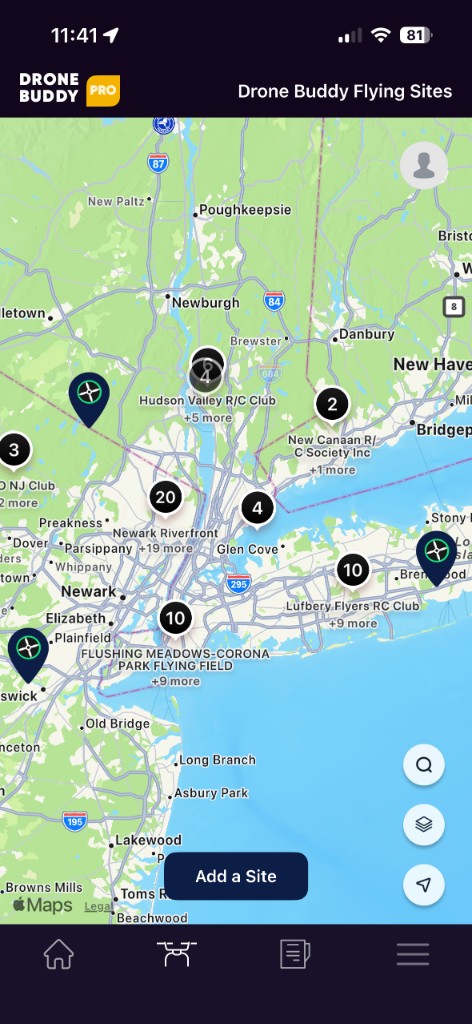
A green airspace map is not permission to stand there. Parks, beaches, and stadiums often ban drones even in Class G. Flying over a neighbor’s house is a different problem from launching in an open field — see can you fly a drone over private property.
For a first flight you want: few people, no water until landing is automatic, no power lines in the hover zone, and room to walk under the aircraft. Start with community pins on the where to fly map, then read the park sign. Those pins are not a permit.
3. Check wind, gusts, and no-fly zones
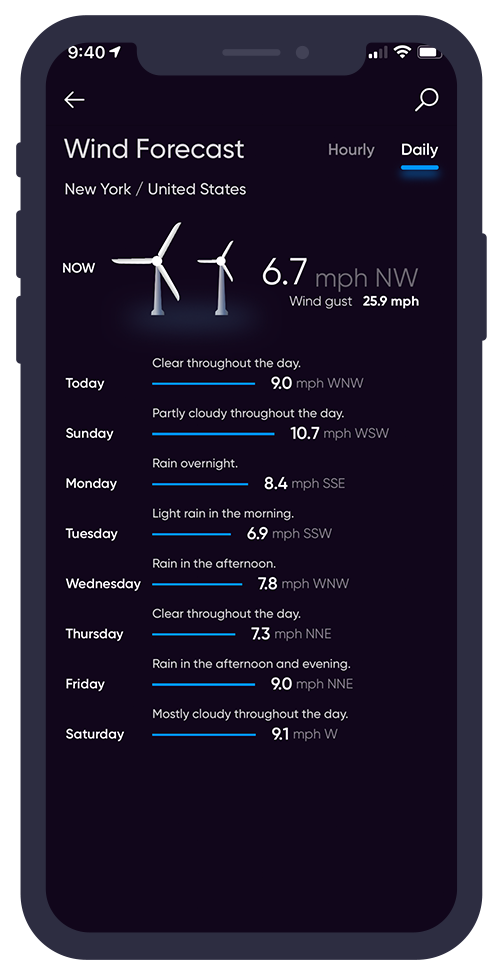
Ground-level breeze is weaker than wind at 200–400 ft. Gusts matter more than the average. If the forecast is near your drone’s published wind rating, stay on the ground. A Mini in 20 mph gusts is how “I only hovered” becomes a flyaway.
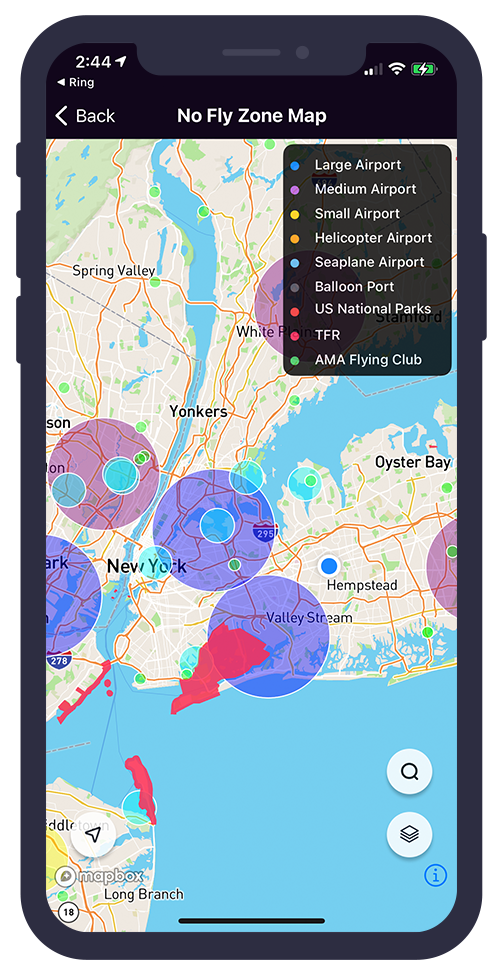
Look at airports, TFRs, and national parks before you leave the house. Treat any no-fly layer as a reference and cross-check official sources for that day. Start with understanding the no-fly zone map. More on how wind affects a flight and how high and how far you can fly.
4. The controls (Mode 2)
Almost every camera drone sold in the US uses Mode 2:
- Left stick — up/down is throttle (climb and descend). Left/right is yaw (rotate the nose).
- Right stick — up/down is pitch (forward and back). Left/right is roll (strafe).
New pilots mash both sticks and the aircraft darts. Learn one axis at a time. Throttle until it hovers, then yaw so you can see which way the nose points, then tiny right-stick inputs. If you cannot tell the front from the back at a glance, you are not ready to go behind a tree.
Turn on beginner / max-distance / max-altitude limits in the fly app for the first sessions. Set return-to-home altitude higher than the tallest trees around the field, or RTH will fly into them.
5. Your first flight
- Charge the aircraft, remote, and phone. Update firmware at home, not in a parking lot with 12% battery.
- Wait for GPS (or the app’s “ready to fly” state). Compass/IMU calibration only if the app asks — not every outing.
- Take off to about head height. Do nothing for 20–30 seconds. If it drifts hard, land and check GPS / stick trim / wind.
- Yaw a slow 360. Practice a climb to ~30 ft and a controlled descent. Then a small square: forward, right, back, left.
- Practice return-to-home from close range once, so you know what the aircraft does, then land it yourself. Do not discover RTH on a low battery over trees.
- Land with reserve. Wind on the way home eats more battery than the outbound leg. Pack up before you are tired and sloppy.
Keep the drone close enough to see attitude with your eyes, not only the screen. Video lag is how people fly into the only tree in the field.
How to fly a DJI drone
DJI Fly (Mini / Air / Flip class) will geofence many airports and warn you in restricted GEO zones. That is not a substitute for the FAA map or a park rule. Unlocking a zone in DJI’s system does not make a city takeoff legal.
Practical DJI habits for beginners:
- Fly in Normal or the beginner limit, not Sport, until hover and landing are boring.
- Set RTH height above obstacles. Confirm home point when you take off, especially if you walked after power-on.
- Obstacle sensors help; they do not see thin branches, wires, or water glare. You still steer.
- A DJI Mini under 250 g is easier to carry, not easier to ignore rules. TRUST still applies. National parks still do not.
FPV (Avata, goggles, motion controller) is a different skill. Do not learn that over a parking lot. Learn a Mini-style hover first, then treat FPV as its own project.
How to fly a drone like a pro (without a $300 course)
“Like a pro” on day one is smooth sticks and a boring plan, not a reel. Pros check wind and airspace, fly with the nose where they can see it, leave battery for the return, and do not fly over people for a shot. Cinematic modes (cinematic / tripod) slow the aircraft so the camera is usable — use them after you can hover without thinking.
If the flight is for money, stop using this hobby checklist and get Part 107. That path is in how to start a drone business.
Common first-week mistakes
- Launching at a crowded park because the map looked empty.
- Trusting phone weather at ground level instead of wind at altitude.
- Flying until 10% battery, then asking the aircraft to punch home into a headwind.
- Looking only at the screen and losing which way the nose points.
- Turning off beginner limits to “see what it can do” on flight two.
- Assuming a backyard HOA, NYC sidewalk, or national-park overlook is fine because someone on YouTube did it.
FAQ
How do you fly a drone for beginners?
Do the legal bits (TRUST or Part 107, register if required), pick an open legal field, check wind and airspace, then hover before you travel. One stick axis at a time. Visual line of sight the whole time.
Do I need a license to fly a drone?
Hobby: TRUST, not Part 107. Work: Part 107. Details in the license guide.
How do I register with FAA DroneZone?
Use faadronezone.faa.gov, register as recreational or non-recreational, pay the fee, mark the number on the aircraft. Required at 0.55 lb and up.
Can I fly a drone in my backyard?
Only with a legal place to stand, legal airspace, and without harassing neighbors. It is a weak classroom. Use a field.
How high can I fly?
Usually 400 ft AGL in uncontrolled airspace, in sight, unless authorization says otherwise. See how high and how far.
How long does it take to learn?
A calm hover and landing: one good session. Reliable in real wind, around people and trees: weeks of short flights, not one afternoon with Sport mode.
After you land, compare what the wind felt like to the forecast. That calibration is how you learn your aircraft. If the field was good, submit it in the app so the next beginner is not starting from a random parking lot.